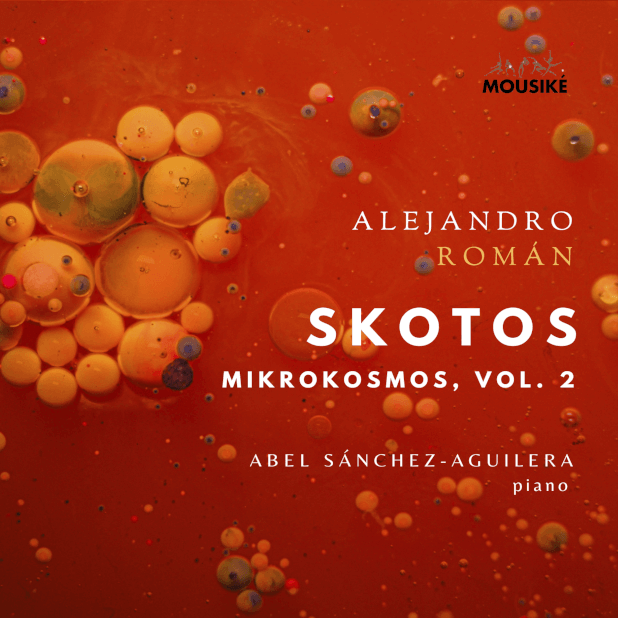
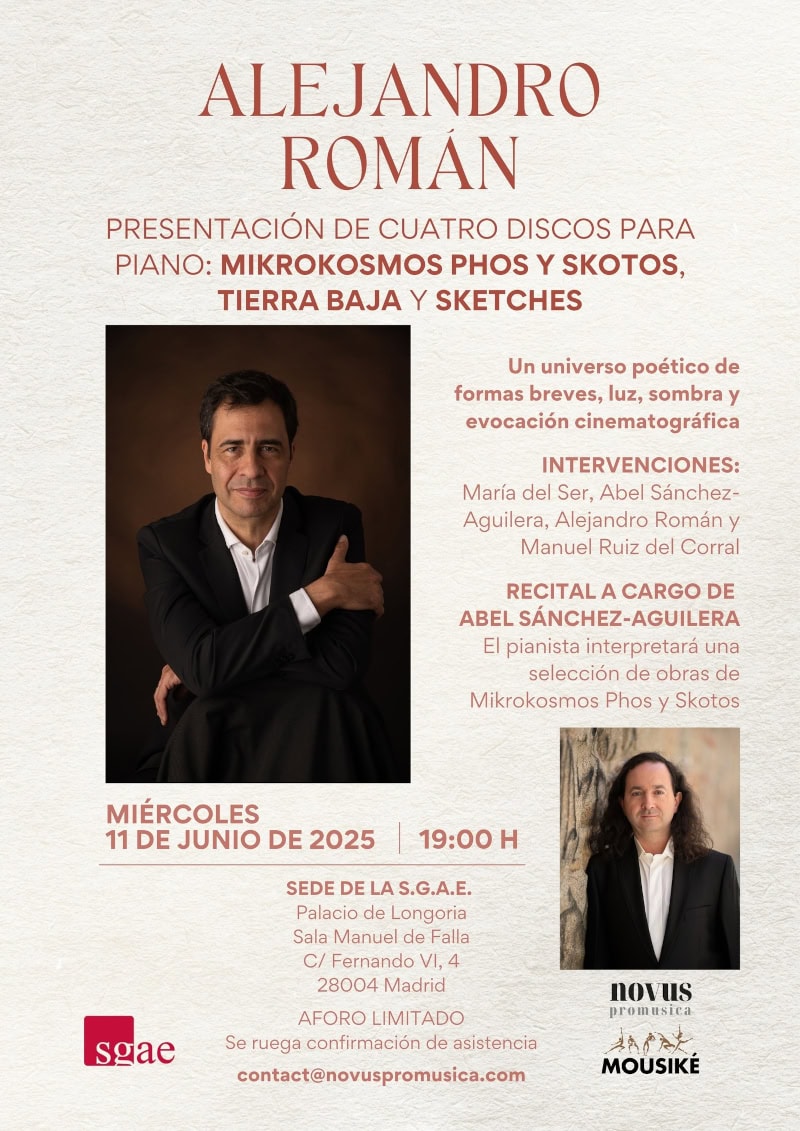
Composer Alejandro Román and I have released Skotos, the second volume of our discographic project Mikrokosmos. It is distributed by Novus Promusica and available in all digital platforms.

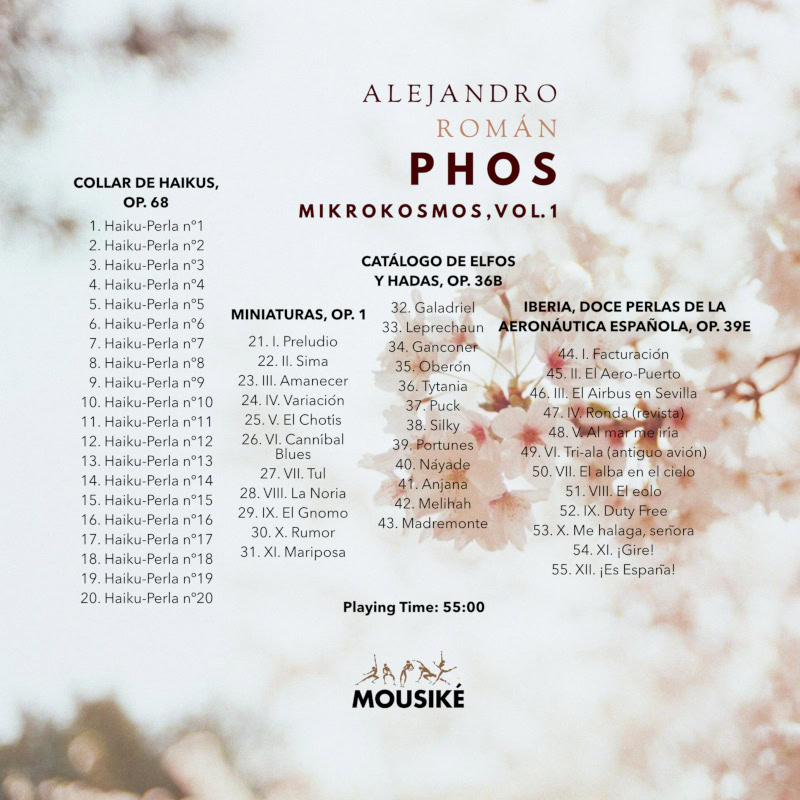
If the first volume, Phos, opened a path toward clarity and essence through a series of luminous miniatures, Skotos invites us into its inevitable counterpart: ambiguity, fragmentation, introspection. This second volume of Mikrokosmos traces a sonic cartography that ventures into the abyssal, into resonant shadows and suggestive textures. Across four very different yet thematically intertwined works, this album proposes a journey inward: from cell to silence, from sea to memory, from technique to raw emotion.
Células, op. 83, was born from the composer’s personal fascination with the microscopic world and its complexity, which becomes here a compositional metaphor. The work comprises 129 micropieces, each a sonic portrair of a unicellular organism inspired by its shape, behaviour, or function. Together they form a larger organism, unified by a network of thematic relations. The work is structured in two books, the first focusing on prokaryotic cells (archaea and bacteria), while the second explores eukaryotic life (protists, fungi and individual human cells). The musical language shifts accordingly: austere for Archaea, rhythmically varied for Monera, harmonically rich for Protista, dense for Fungi, and deeply human in Animalia, which closes with three pieces portraying human cells. Played continuously without breaks, these musical cells create an organic and immersive experience.
Entre arrecifes, op. 11 is a brief but poignant work written as an allegory of human existence. Coral reefs—beautiful yet hazardous formations in shallow waters— represent here the coexistence of beauty and danger. Life between reefs, like life itself, is alluring but fraught with hidden threats. The music flows like a gentle underwater current, interrupted by harmonic tensions and sudden shifts, echoing the unpredictable paths we navigate in life.
OidaRadio 2, op. 59 was composed in 2015 to mark the 50th anniversary of Spain’s national classical music station, Radio Clásica. The piece pays tribute both to the broadcaster and to the fugue as a historical musical form. The title is a phonetic palindrome: “radio” reversed becomes “oida(r)” (“heard”), reflecting the dual nature of the piece—about listening, about media, about inversion. Based on a two-voice twelve-tone invention from Román’s student days, the work unfolds as a Prelude and fugue in 5/4 time (five letters, two voices—”Radio 2”). Four musical palindromes are derived from the letters r-a-d-i-o using twelve-tone techniques. Structurally, the fugue follows a traditional model: exposition, episodes, stretto, pedal point, and coda. The final section, quotes note-for-note the two-part fugue in E minor (BWV 855) from Bach’s Well-Tempered Clavier, superimposed over the rhythmic frame of his own fugue. The result is a piece of structural ingenuity, historical homage, and musical depth.
The album concludes with Piezas Tétricas, Op. 64, a trilogy of short piano works originally written for the 2010 short film Quédate conmigo by Zoe Berriatia—a strange and emotionally intense love story with horror overtones. The music, like the film, deals not with abstract darkness but with emotional death: loss, cruelty, vulnerability. The titles are revealing: I’m Dead, That has been very cruel, Stay with me. Each piece evokes a distinct psychological state. The first is stark and resigned, the second more dramatic and piercing, the third is almost a whispered plea. The musical language is sober, with shadowy harmonies, broken lines, and silences charged with emotion.





 ABEL SÁNCHEZ-AGUILERA