I am happy to announce the release of my third album: Mikrokosmos, Vol. 1 “Phos”, distributed by Novus Promusica and available in digital platforms.
This album, the first volume of a double project whose counterpart (Skotos) will explore darker territories, brings together a selection of piano works by Alejandro Román focused on luminosity, essence, and evocation. Each piece contains a microcosm of sound, where brevity is not a limitation but a vessel of poetic concentration. The album reveals a sonic world full of nuance, lyricism, humor, and character.
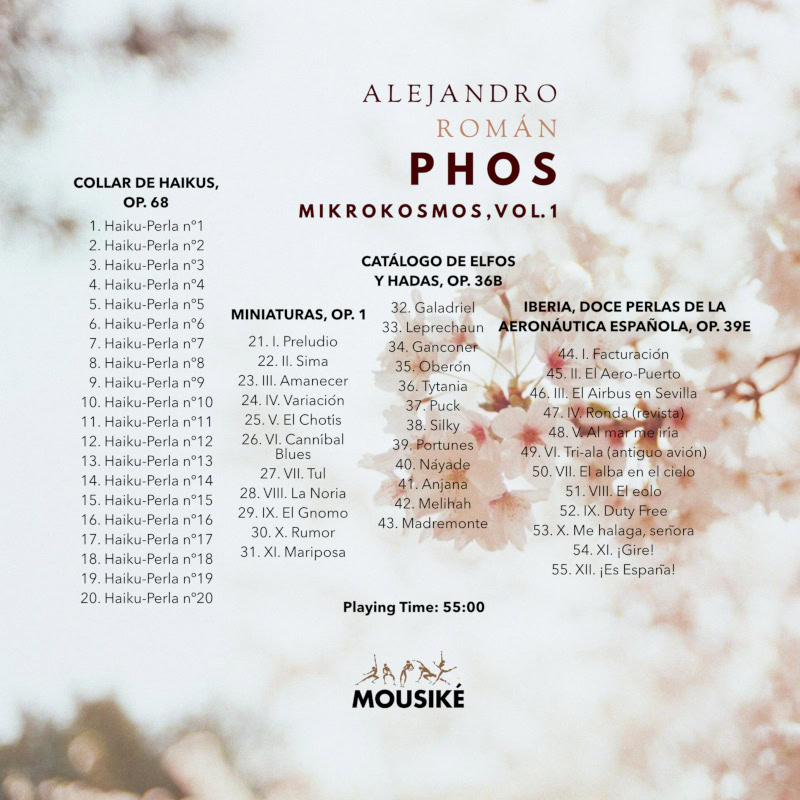
The album opens with Collar de Haikus, Op. 68, a collection of twenty micropieces for piano conceived as musical translations of Japanese haikus. Román found in this poetic genre—defined by its brief structure (5-7-5 syllables), connection with nature, and the evocation of fleeting imagery—the perfect excuse to explore formal condensation in music. Each piece is a sound study, employing a variety of compositional techniques— pandiatonicism, quartal harmony, twelve-tone rows, Japanese pentatonics, among others— like different brushes to paint delicate and profound sonic landscapes, always open to the listener’s imagination. The brevity of each musical haiku allows its resonance to linger in time, like a bead on a long necklace.
The second piece, Miniaturas, Op. 1, is the first work in Roman’s piano catalogue. Composed in 1997, it consists of eleven short pieces inspired by the world of Erik Satie, particularly Sports et Divertissements. Each one represents an object, phenomenon, or character—such as a deep crevice (Sima), the dawn (Amanecer), a traditional Madrid dance (Chotis), a flying insect (Mariposa), or a fairy tale gnome. The collection begins with a Prelude which is later developed with a Variation of the same; in total, eleven short pieces in a cycle as if it were a small theatre of the everyday. Although it was conceived in an accessible language, each piece contains a clear and poetic intention, which reveals the creative personality of its author.
Catalogo de Elfos y Hadas, Op. 36b (Catalogue of Elves and Fairies) transports us into an enchanted realm. This piano suite, arranged for piano in 2015 from a work originally written for harp in 2008, is a tribute to the fairy tales and legendary creatures found in the folklore of many countries. Divided into two notebooks—Elves and Fairies—each miniature portrays a specific character rooted in traditions from Germany, France, England, Spain, Greece, Colombia, and more. The pieces are modeled on musical forms associated with their respective origins: Celtic gigues, Spanish folias, Colombian bullerengues, Andalusian zambras, lullabies… In this sense, the suite functions like a Baroque dance collection, but reimagined with a contemporary language full of humor, lyricism, and theatricality. Though inspired by fantasy, the work is not only or children—it is also for adults who still cherish the power of imagination.
The album concludes with Iberia, doce perlas de la aeronautica espaiola, Op. 39e (Iberia: Twelve Pearls of Spanish Aeronautics), a work for piano four hands that is both a tribute to and a loving parody of Isaac Albéniz’s Iberia. Composed in 2009 to mark the centenary of Albéniz’s death, each miniature corresponds to one of the orlglnal pieces from Iberia, reimagined through a humorous lens and connected to Spanish aviation. For instance, Evocacion becomes Check-in, El Puerto becomes The Air-port, Corpus Christi in Seville becomes The Airbus in Seville, and so on. These transformations are crafted with irony, affection, and a “Satienian” sense of wit. All the thematic material is derived from Albéniz’s originals, yet presented in a distilled, playful form. This version for piano four hands was commissioned by Abel Sanchez-Aguilera and Maria Lukina, and is dedicated to both.
 ABEL SÁNCHEZ-AGUILERA
Leave a comment